<?xml version="1.0" encoding="UTF-8" standalone="yes"?>
<?xml-stylesheet type="text/css" href="css/atom.css"?>
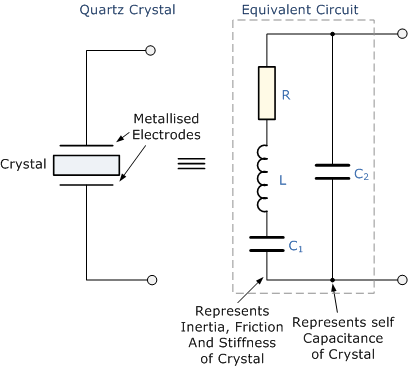
<feed xmlns="http://www.w3.org/2005/Atom"><title type="html"><![CDATA[Suntan Capacitors Blog]]></title><subtitle type="html"><![CDATA[offer all kinds of Capacitors informations]]></subtitle><id>http://www.capacitors.hk/blog/</id><link rel="alternate" type="text/html" href="http://www.capacitors.hk/blog/"/><link rel="self" type="application/atom+xml" href="http://www.capacitors.hk/blog/atom.xml"/><generator uri="http://www.rainbowsoft.org/" version="1.8 Devo Build 80201">RainbowSoft Studio Z-Blog</generator><updated>2010-12-30T23:25:49+08:00</updated><entry><title type="html"><![CDATA[What is BGA mean?]]></title><author><name>admin</name><email>a@b.com</email></author><category term="" scheme="http://www.capacitors.hk/blog/post/about-capacitors.html" label="About Capacitors"/><updated>2010-12-30T23:24:22+08:00</updated><published>2010-12-30T23:24:22+08:00</published><summary type="html"><![CDATA[<p>BGA (Ball Grid Array) is one type of packaging for surface-mounted integrated electronic circuits (integrated circuits whose components are actually 'mounted' or affixed on the surface of the printed circuit semiconductor board). A BGA package simply looks like a thin wafer of semi-conducting material that has circuit components on only one face. The Ball Grid Array package is called such because it is basically an array of metal alloy balls arranged in a grid.</p>]]></summary><link rel="alternate" type="text/html" href="http://www.capacitors.hk/blog/post/153.html"/><id>http://www.capacitors.hk/blog/post/153.html</id></entry><entry><title type="html"><![CDATA[Integrated circuit packages]]></title><author><name>admin</name><email>a@b.com</email></author><category term="" scheme="http://www.capacitors.hk/blog/post/about-capacitors.html" label="About Capacitors"/><updated>2010-12-30T23:22:41+08:00</updated><published>2010-12-30T23:22:41+08:00</published><summary type="html"><![CDATA[<ul>    <li>SOIC - Small Outline Integrated Circuit. This has a dual in line configuration and gull wing leads with a pin spacing of 1.27 mm</li>    <li>TSOP - Thin Small Outline Package. This package is thinner than the SOIC and has a smaller pin spacing of 0.5 mm</li>    <li>SSOP - Shrink Small Outline Package. This has a pin spacing of 0.635 mm</li>    <li>TSSOP - Thin Shrink Small Outline Package.</li>    <li>PLCC - Plastic Leaded Chip Carrier. This type of package is square and uses J-lead pins with a spacing of 1.27 mm</li>    <li>QSOP - Quarter-size Small Outline Package. It has a pin spacing of 0.635 mm</li>    <li>VSOP - Very Small Outline Package. This is smaller than the QSOP and has pin spacing of 0.4, 0.5, or 0.65 mm.</li>    <li>LQFP - Low profile Quad Flat Pack. This package has pins on all four sides. Pin spacing varies according to the IC, but the height is 1.4 mm.</li>    <li>PQFP - Plastic Quad Flat Pack. A square plastic package with equal number of gull wing style pins on each side. Typically narrow spacing and often 44 or more pins. Normally used for VLSI circuits.</li>    <li>CQFP - Ceramic Quad Flat Pack. A ceramic version of the PQFP.</li>    <li>TQFP - Thin Quad Flat Pack. A thin version of the PQFP.</li>    <li>BGA - Ball Grid Array. A package that uses pads underneath the package to make contact wit the printed circuit board.</li></ul><p>Before soldering the pads appear as solder balls, giving rise to the name. By placing the pads underneath the package there is more room for them, thereby overcoming some of the problems of the very thin leads required for the quad flat packs. The ball spacing on BGAs is typically 1.27 mm.</p>]]></summary><link rel="alternate" type="text/html" href="http://www.capacitors.hk/blog/post/152.html"/><id>http://www.capacitors.hk/blog/post/152.html</id></entry><entry><title type="html"><![CDATA[Transistor packages]]></title><author><name>admin</name><email>a@b.com</email></author><category term="" scheme="http://www.capacitors.hk/blog/post/about-capacitors.html" label="About Capacitors"/><updated>2010-12-23T05:13:07+08:00</updated><published>2010-12-23T05:13:07+08:00</published><summary type="html"><![CDATA[<p>SOT-23 - Small Outline Transistor. This is SMT package has three terminals for a diode of transistor, bit it can have more pins when it may be used for small integrated circuits such as an operational amplifier, etc. It measures 3 mm x 1.75 mm x 1.3 mm</p><p>SOT-223 - Small Outline Transistor. This package is used for higher power devices. It measures 6.7 mm x 3.7 mm x 1.8 mm. There are generally four terminals, one of which is a large heat-transfer pad.</p>]]></summary><link rel="alternate" type="text/html" href="http://www.capacitors.hk/blog/post/151.html"/><id>http://www.capacitors.hk/blog/post/151.html</id></entry><entry><title type="html"><![CDATA[EIA specifications of Tantalum SMT Capacitors packages]]></title><author><name>admin</name><email>a@b.com</email></author><category term="" scheme="http://www.capacitors.hk/blog/post/about-capacitors.html" label="About Capacitors"/><updated>2010-12-22T05:07:18+08:00</updated><published>2010-12-22T05:07:18+08:00</published><summary type="html"><![CDATA[<p>As a result of the different construction and requirements for Tantalum SMT Capacitors, there are some different packages that are used for them. These conform to EIA specifications.</p><table border="0" cellspacing="0" cellpadding="0" width="100%">    <tbody>        <tr>            <td>Package type</td>            <td>Dimensions mm</td>            <td>EIA Standard</td>        </tr>        <tr>            <td>Size A</td>            <td>3.2 x 1.6 x 1.6</td>            <td>EIA 3216-18</td>        </tr>        <tr>            <td>Size B</td>            <td>3.5 x 2.8 x 1.9</td>            <td>EIA 3528-21</td>        </tr>        <tr>            <td>Size C</td>            <td>6.0 x 3.2 x 2.2</td>            <td>EIA 6032-28</td>        </tr>        <tr>            <td>Size D</td>            <td>7.3 x 4.3 x 2.4</td>            <td>EIA 7343-31</td>        </tr>        <tr>            <td>Size E</td>            <td>7.3 x 4.3 x 4.1</td>            <td>EIA 7343-43</td>        </tr>    </tbody></table>]]></summary><link rel="alternate" type="text/html" href="http://www.capacitors.hk/blog/post/150.html"/><id>http://www.capacitors.hk/blog/post/150.html</id></entry><entry><title type="html"><![CDATA[SMT components of Resistors and Capacitors]]></title><author><name>admin</name><email>a@b.com</email></author><category term="" scheme="http://www.capacitors.hk/blog/post/about-capacitors.html" label="About Capacitors"/><updated>2010-12-21T11:10:18+08:00</updated><published>2010-12-21T11:10:18+08:00</published><summary type="html"><![CDATA[<p>These SMT components are mainly resistors and capacitors which form the bulk of the number of components used. There are several different sizes which have been reduced as technology has enabled smaller components to be manufactured and used.</p><table cellspacing="0" cellpadding="0" width="100%">    <tbody>        <tr>            <td>Package type</td>            <td>Dimensions mm</td>            <td>Dimensions Imches</td>        </tr>        <tr>            <td>1812</td>            <td>4.6 x 3.0</td>            <td>0.18 x 0.12</td>        </tr>        <tr>            <td>1206</td>            <td>3.0 x 1.5</td>            <td>0.12 x 0.06</td>        </tr>        <tr>            <td>0805</td>            <td>2.0 x 1.3</td>            <td>0.08 x 0.05</td>        </tr>        <tr>            <td>0603</td>            <td>1.5 x 0.8</td>            <td>0.06 x 0.03</td>        </tr>        <tr>            <td>0402</td>            <td>1.0 x 0.5</td>            <td>0.04 x 0.02</td>        </tr>        <tr>            <td>0201</td>            <td>0.6 x 0.3</td>            <td>0.02 x 0.01</td>        </tr>    </tbody></table><p>Of these sizes, the 1812, and 1206 sizes are now only used for specialized components or ones requiring larger levels of power to be dissipated The 0603 and 0402 SMT sizes are the most widely used.</p>]]></summary><link rel="alternate" type="text/html" href="http://www.capacitors.hk/blog/post/149.html"/><id>http://www.capacitors.hk/blog/post/149.html</id></entry><entry><title type="html"><![CDATA[Surge Capacitor Informations]]></title><author><name>admin</name><email>a@b.com</email></author><category term="" scheme="http://www.capacitors.hk/blog/post/about-capacitors.html" label="About Capacitors"/><updated>2010-12-20T11:08:05+08:00</updated><published>2010-12-20T11:08:05+08:00</published><summary type="html"><![CDATA[<p>A surge capacitor is a device designed to absorb surges and/or reduce the steepness of their wave front. A capacitor is able to absorb and hold a charge of electricity, returning it to the circuit at a later time. Since the surge capacitor is always connected to the power circuit, current flows at all times. When a surge occurs, added current flows to the capacitor thereby lowering the intensity of the surge voltage. The amount of current the capacitor can absorb depends on the size of the capacitor, and the amount of voltage pushing the current.</p><p>If the surge is of a low current relative to its voltage intensity, the capacitor will absorb it. If the surge has high current, the capacitor cannot absorb it.</p><p>The main advantage of a capacitor is that there is no time delay in turning on as it always conducts. The disadvantage is that the amount of current it can handle is limited to a few amps, depending on the surge voltage. For this reason, an arrestor should always be installed with a capacitor to protect it from intense surges.</p>]]></summary><link rel="alternate" type="text/html" href="http://www.capacitors.hk/blog/post/148.html"/><id>http://www.capacitors.hk/blog/post/148.html</id></entry><entry><title type="html"><![CDATA[A Good-Sounding Capacitor is Essential!]]></title><author><name>admin</name><email>a@b.com</email></author><category term="" scheme="http://www.capacitors.hk/blog/post/about-capacitors.html" label="About Capacitors"/><updated>2010-12-18T12:38:47+08:00</updated><published>2010-12-18T12:38:47+08:00</published><summary type="html"><![CDATA[<p>Coupling capacitors are used in all tube gear. The audio signal gets from one tube to the next through these electrical components. For over twenty years, audiophiles and audio designers have been aware that not all caps sound alike. Capacitors can make a huge difference in the sound of equipment.</p><p>In the original Counterpoint gear for the upgrades, use different capacitors depending on the unit being upgraded, and the desired cost/benefit ratio.</p>]]></summary><link rel="alternate" type="text/html" href="http://www.capacitors.hk/blog/post/147.html"/><id>http://www.capacitors.hk/blog/post/147.html</id></entry><entry><title type="html"><![CDATA[Suntan Capacitors Technology Co. Ltd 's good offer]]></title><author><name>admin</name><email>a@b.com</email></author><category term="" scheme="http://www.capacitors.hk/blog/post/Ceramic-Capacitors.html" label="Ceramic Capacitors"/><updated>2010-12-17T12:30:52+08:00</updated><published>2010-12-17T12:30:52+08:00</published><summary type="html"><![CDATA[<p>Suntan Capacitors Technology Co. Ltd. is offering a complete line of Aluminum Electrolytic, Metallized Film, and Tantalum Capacitors, including a full complement of technical specifications, product descriptions, and performance characteristics with charts, graphs, and application guidelines to aid in choosing the right capacitor to meet your application requirements.</p><p><strong>Below introduce you High Voltage Ceramic Capacitors &ndash; TS16</strong></p><p>Use for coupling, and by-pass circuit there are a stable and high reliability products.</p><table border="0" cellspacing="0" cellpadding="0" width="100%">    <tbody>        <tr>            <td>High Voltage Ceramic Capacitor Specifications:</td>            <td rowspan="6"><img onload="ResizeImage(this,520)" src="http://www.capacitors.hk/blog/upload/ts16.gif" alt="" title=""/></td>        </tr>        <tr>            <td>Operating Condition Range: -25℃ to +85℃</td>        </tr>        <tr>            <td>Rated Working Voltage: 1 KV 50KVDC</td>        </tr>        <tr>            <td>Capacitance Range: 100pF - 10,000pF</td>        </tr>        <tr>            <td>Test Voltage: 2 times of the rated voltage.</td>        </tr>        <tr>            <td>Insulation Resistance: 10,000 m&Omega; or 200 m&Omega; whichever is the smaller</td>        </tr>    </tbody></table><p>For more details please contact us. We are waiting for your inquires.</p>]]></summary><link rel="alternate" type="text/html" href="http://www.capacitors.hk/blog/post/146.html"/><id>http://www.capacitors.hk/blog/post/146.html</id></entry><entry><title type="html"><![CDATA[Non-polarized fixed capacitor]]></title><author><name>admin</name><email>a@b.com</email></author><category term="" scheme="http://www.capacitors.hk/blog/post/about-capacitors.html" label="About Capacitors"/><updated>2010-12-16T01:07:18+08:00</updated><published>2010-12-16T01:07:18+08:00</published><summary type="html"><![CDATA[<p>A non-polarized (&quot;non polar&quot;) capacitor is a type of capacitor that has no implicit polarity -- it can be connected either way in a circuit. Ceramic, mica and some electrolytic capacitors are non-polarized. You'll also sometimes hear people call them &quot;bipolar&quot; capacitors.</p>]]></summary><link rel="alternate" type="text/html" href="http://www.capacitors.hk/blog/post/145.html"/><id>http://www.capacitors.hk/blog/post/145.html</id></entry><entry><title type="html"><![CDATA[The Capacitors]]></title><author><name>admin</name><email>a@b.com</email></author><category term="" scheme="http://www.capacitors.hk/blog/post/about-capacitors.html" label="About Capacitors"/><updated>2010-12-14T22:12:36+08:00</updated><published>2010-12-14T22:12:36+08:00</published><summary type="html"><![CDATA[<p>A capacitor is an electronic component that stores energy in the electric field created between a pair of conductors on which equal but opposite electric charges have been placed. Capacitors are used for a variety of purposes including signal coupling, motor starting, energy storage, power factor correction, voltage regulation, tuning, resonance and filtration. Capacitors are energy storage devices that are commonly used to supply these energy bursts by storing energy in a circuit and delivering the energy upon timed demand. A capacitor stores a charge and then supplies the charge required for the operation of a electrical device, such as audio amplifiers, surge protectors, power supplies, switching regulators, motor control regulators, computer electronics, and resistance spot welders. These electrical devices often require substantial bursts of energy in their operation. Microelectronic capacitors are becoming increasingly important in microelectronic devices. Microelectronic capacitors have been widely used in integrated circuit memory devices, such as dynamic random access memory (DRAM) devices. A capacitor is typically made of two parallel surfaces or plates, each of which is an electrode. In order to obtain a high capacitance, a large dielectric surface area is used, the dielectric may be a gas, liquid, solid, or vacuum.</p>]]></summary><link rel="alternate" type="text/html" href="http://www.capacitors.hk/blog/post/143.html"/><id>http://www.capacitors.hk/blog/post/143.html</id></entry><entry><title type="html"><![CDATA[Voltage]]></title><author><name>admin</name><email>a@b.com</email></author><category term="" scheme="http://www.capacitors.hk/blog/post/about-capacitors.html" label="About Capacitors"/><updated>2010-12-14T21:55:05+08:00</updated><published>2010-12-14T21:55:05+08:00</published><summary type="html"><![CDATA[<p>Voltage is supplied by the battery (or power supply).<br />Voltage is used up in components, but not in wires.<br />We say voltage across a component.<br />Voltage is measured with a voltmeter, connected in parallel.</p>]]></summary><link rel="alternate" type="text/html" href="http://www.capacitors.hk/blog/post/144.html"/><id>http://www.capacitors.hk/blog/post/144.html</id></entry><entry><title type="html"><![CDATA[High stability is the important of a Quartz Crystal in Crystal Oscillators]]></title><author><name>admin</name><email>a@b.com</email></author><category term="" scheme="http://www.capacitors.hk/blog/post/Quartz-Crystal.html" label="Quartz Crystal"/><updated>2010-12-13T00:38:10+08:00</updated><published>2010-12-13T00:38:10+08:00</published><summary type="html"><![CDATA[<p>One of the most important features of an oscillator is its Frequency Stability, or in other words its ability to provide a constant frequency output under varying conditions. Some of the factors that affect the frequency stability of an oscillator include: temperature, variations in the load and changes in the power supply. Frequency stability of the output signal can be improved by the proper selection of the components used for the resonant feedback circuit including the amplifier but there is a limit to the stability that can be obtained from normal LC and RC tank circuits. For very high stability a quartz crystal is generally used as the frequency determining device to produce another types of oscillator circuit known generally as Crystal Oscillators.</p><p>Suntan offer the high stability Quartz Crystal. So you don&rsquo;t miss to know more about capacitors in Suntan. Welcome to send the inquire for us and call us to send the capacitors samples for your good view.</p>]]></summary><link rel="alternate" type="text/html" href="http://www.capacitors.hk/blog/post/142.html"/><id>http://www.capacitors.hk/blog/post/142.html</id></entry><entry><title type="html"><![CDATA[Ohm's Law]]></title><author><name>admin</name><email>a@b.com</email></author><category term="" scheme="http://www.capacitors.hk/blog/post/about-capacitors.html" label="About Capacitors"/><updated>2010-12-11T00:35:08+08:00</updated><published>2010-12-11T00:35:08+08:00</published><summary type="html"><![CDATA[<p>Ohm's Law is the linear proportionality between current and voltage that occurs for most conductors of electricity. A graph of voltage against current is a straight line. The gradient is the resistance.</p><p>The most well known form of Ohm's law is V=IR, where V is the voltage, I is the current and R is the resistance. However there is another form of Ohm's law which often used by physicists that operates on a microscopic level, relating the current density J to the conductivity &sigma; and the electric field, E.</p><p>To see how consider, the volume of material with faces of area A a distance I apart. With an e.m.f. V across the faces of the material:</p><p>the current is proportional to the voltage V<br />the current is proportional to the surface area A<br />and the current is inversely proportional to the distance I.<br />The current is therefore,</p><p>I = VA&sigma;/I.</p><p>R = I/A&sigma;</p><p>The proportionality constant &sigma; is the conductivity of the material.</p><p>V/I = |E|, and J = I/A in the direction of E so in general we have the constitutive relation.</p><p>J = &sigma;E</p>]]></summary><link rel="alternate" type="text/html" href="http://www.capacitors.hk/blog/post/141.html"/><id>http://www.capacitors.hk/blog/post/141.html</id></entry><entry><title type="html"><![CDATA[Power Rating for various Appliances in the Home]]></title><author><name>admin</name><email>a@b.com</email></author><category term="" scheme="http://www.capacitors.hk/blog/post/about-capacitors.html" label="About Capacitors"/><updated>2010-12-10T22:31:03+08:00</updated><published>2010-12-10T22:31:03+08:00</published><summary type="html"><![CDATA[<p>Electrical appliances used around the home are rated in Watts and electricity is sold by the kilowatt-hour. This is equivalent energy used by a device rated at 1000 W running for 1 hour, or 3.6 x 10⁶ J. This is also the same energy as a Board of Trade Unit (BTU) (Not to be confused with the (British Thermal Unit) b.t.u. which describes the power of heating and cooling systems.)</p><p>To give some idea of how much energy electrical items consume the table below lists various electrical appliances and their power ratings.</p><table border="0" cellspacing="0" cellpadding="0" width="100%"><tbody><tr><td>Appliance</td><td>Power Rating (W)</td></tr><tr><td>Water Heater</td><td>4000</td></tr><tr><td>Electric Cooker, Hob (one ring)</td><td>2000</td></tr><tr><td>Electric Cooker, Oven</td><td>1500-2500</td></tr><tr><td>Microwave Oven</td><td>600-900</td></tr><tr><td>Washing Machine</td><td>2750</td></tr><tr><td>Vacuum Cleaner</td><td>800 - 1200</td></tr><tr><td>Toaster</td><td>1200</td></tr><tr><td>Electric Kettle</td><td>1200 - 2200</td></tr><tr><td>Hair Dryer</td><td>1000</td></tr><tr><td>Plasma Television</td><td>328</td></tr><tr><td>LCD Television</td><td>193</td></tr><tr><td>CRT Television</td><td>146</td></tr><tr><td>Fridge</td><td>110</td></tr><tr><td>Incandescent Light Bulb</td><td>40 - 100</td></tr><tr><td>Computer</td><td>78</td></tr><tr><td>Laptop Computer</td><td>65</td></tr><tr><td>PlayStation II</td><td>30</td></tr><tr><td>Energy Efficient Light Bulb</td><td>15</td></tr><tr><td>Wireless Router</td><td>7</td></tr><tr><td>CRT Standby</td><td>3 - 11</td></tr><tr><td>Charging Mobile Phone</td><td>3</td></tr><tr><td>Solar Powered Calculator</td><td>0.04</td></tr></tbody></table><p>The actual cost of running all this equipment depends on how much a kilowatt of power costs and how long you use each appliance. However, it is clear that the most power hungry appliances are those used for heating things. What is surprising, is the high power consumption of LCD televisions in comparison to traditional CRTs.</p>]]></summary><link rel="alternate" type="text/html" href="http://www.capacitors.hk/blog/post/140.html"/><id>http://www.capacitors.hk/blog/post/140.html</id></entry><entry><title type="html"><![CDATA[Super Capacitors]]></title><author><name>admin</name><email>a@b.com</email></author><category term="" scheme="http://www.capacitors.hk/blog/post/about-capacitors.html" label="About Capacitors"/><updated>2010-12-09T11:12:53+08:00</updated><published>2010-12-09T11:12:53+08:00</published><summary type="html"><![CDATA[<p>Super Capacitors are capacitors which have the ability to store large amounts of charge, and therefore energy, in a very small volume. Energy storage is by means of static charge rather than of an electro-chemical process that is inherent to the battery. Applying a voltage differential on the positive and negative plates charges the super Capacitor. This concept is similar to an electrical charge that builds up when walking on a carpet. The super Capacitor was first conceived in 1957 but now research is focused on using these as a light weight power sources as an alternative for batteries. The super Capacitor crosses into battery technology by using special electrodes and some electrolyte.</p><p>Super Capacitors could find applications such as temporary back-up power supplies in the electrical power grid or providing the initial burst of energy to get electric cars moving.</p>]]></summary><link rel="alternate" type="text/html" href="http://www.capacitors.hk/blog/post/139.html"/><id>http://www.capacitors.hk/blog/post/139.html</id></entry><entry><title type="html"><![CDATA[Tantalum Capacitors]]></title><author><name>admin</name><email>a@b.com</email></author><category term="" scheme="http://www.capacitors.hk/blog/post/Tantalum-Capacitors.html" label="Tantalum Capacitors"/><updated>2010-12-08T11:07:51+08:00</updated><published>2010-12-08T11:07:51+08:00</published><summary type="html"><![CDATA[<p>Tantalum capacitors are polarised and have low voltage ratings like electrolytic capacitors. They are expensive but very small so they are used where a large capacitance is needed in a small size such as mobile phones or laptop computers. These capacitors have increasingly become an important as the demand for ever smaller electronic gadgets has grown. Columbite-tantalite &ndash; coltan for short, the ore from which tantalum is refined is mined in Australia, Egypt.</p>]]></summary><link rel="alternate" type="text/html" href="http://www.capacitors.hk/blog/post/138.html"/><id>http://www.capacitors.hk/blog/post/138.html</id></entry><entry><title type="html"><![CDATA[You know the Quartz Crystal used in Crystal Oscillators?]]></title><author><name>admin</name><email>a@b.com</email></author><category term="" scheme="http://www.capacitors.hk/blog/post/Quartz-Crystal.html" label="Quartz Crystal"/><updated>2010-12-07T11:04:00+08:00</updated><published>2010-12-07T11:04:00+08:00</published><summary type="html"><![CDATA[<p>The Quartz Crystal used in Crystal Oscillators is a very small, thin piece or wafer of cut Quartz with the two parallel surfaces metallized to make the electrical connections. The physical size and thickness of a piece of Quartz Crystal is tightly controlled since it affects the final frequency of oscillations and is called the crystals &quot;characteristic frequency&quot;. Then once cut and shaped the crystal can not be used at any other frequency. The crystals characteristic or resonant frequency is inversely proportional to its physical thickness between the two metallized surfaces. A mechanically vibrating crystal can be represented by an equivalent electrical circuit consisting of low Resistance, large Inductance and small Capacitance as shown below.</p><p><img onload="ResizeImage(this,520)" src="http://www.capacitors.hk/blog/upload/Quartz-Crystal.gif" alt="" title=""/></p>]]></summary><link rel="alternate" type="text/html" href="http://www.capacitors.hk/blog/post/137.html"/><id>http://www.capacitors.hk/blog/post/137.html</id></entry><entry><title type="html"><![CDATA[A case when a circuit tester]]></title><author><name>admin</name><email>a@b.com</email></author><category term="" scheme="http://www.capacitors.hk/blog/post/about-capacitors.html" label="About Capacitors"/><updated>2010-12-06T11:00:27+08:00</updated><published>2010-12-06T11:00:27+08:00</published><summary type="html"><![CDATA[<p>When a circuit tester, such as an analog meter set to measure resistance, is connected to a 10 microfarad (&micro;F) electrolytic capacitor, a current will flow, but only for a moment. You can confirm that the meter's needle moves off of zero, but returns to zero right away.</p><p>When you connect the meter's probes to the capacitor in reverse, you will note that current once again flows for a moment. Once again, when the capacitor has fully charged, the current stops flowing. So the capacitor can be used as a filter that blocks DC current. (A &quot;DC cut&quot; filter.)</p><p>However, in the case of alternating current, the current will be allowed to pass. Alternating current is similar to repeatedly switching the test meter's probes back and forth on the capacitor. Current flows every time the probes are switched.</p>]]></summary><link rel="alternate" type="text/html" href="http://www.capacitors.hk/blog/post/136.html"/><id>http://www.capacitors.hk/blog/post/136.html</id></entry><entry><title type="html"><![CDATA[Brief summary of Capacitors]]></title><author><name>admin</name><email>a@b.com</email></author><category term="" scheme="http://www.capacitors.hk/blog/post/about-capacitors.html" label="About Capacitors"/><updated>2010-12-04T14:22:04+08:00</updated><published>2010-12-04T14:22:04+08:00</published><summary type="html"><![CDATA[<p>The capacitor's function is to store electricity, or electrical energy.<br />The capacitor also functions as a filter, passing alternating current (AC), and blocking direct current (DC).<br />This symbol <img alt="" align="top" height="12" src="http://www.piclist.com/images/www/hobby_elec/gif/condmark.gif" /> is used to indicate a capacitor in a circuit diagram.<br /><br />The capacitor is constructed with two electrode plates facing eachother, but separated by an insulator.<br /><br />When DC voltage is applied to the capacitor, an electric charge is stored on each electrode. While the capacitor is charging up, current flows. The current will stop flowing when the capacitor has fully charged.</p>]]></summary><link rel="alternate" type="text/html" href="http://www.capacitors.hk/blog/post/135.html"/><id>http://www.capacitors.hk/blog/post/135.html</id></entry><entry><title type="html"><![CDATA[Pay attention of the breakdown voltage]]></title><author><name>admin</name><email>a@b.com</email></author><category term="" scheme="http://www.capacitors.hk/blog/post/about-capacitors.html" label="About Capacitors"/><updated>2010-12-03T00:49:20+08:00</updated><published>2010-12-03T00:49:20+08:00</published><summary type="html"><![CDATA[<p>When using a capacitor, you must pay attention to the maximum voltage which can be used. This is the &quot;breakdown voltage.&quot; The breakdown voltage depends on the kind of capacitor being used. You must be especially careful with electrolytic capacitors because the breakdown voltage is comparatively low. The breakdown voltage of electrolytic capacitors is displayed as Working Voltage.</p><p>The breakdown voltage is the voltage that when exceeded will cause the dielectric (insulator) inside the capacitor to break down and conduct. When this happens, the failure can be catastrophic.</p>]]></summary><link rel="alternate" type="text/html" href="http://www.capacitors.hk/blog/post/134.html"/><id>http://www.capacitors.hk/blog/post/134.html</id></entry><entry><title type="html"><![CDATA[An important property of a dielectric]]></title><author><name>admin</name><email>a@b.com</email></author><category term="" scheme="http://www.capacitors.hk/blog/post/about-capacitors.html" label="About Capacitors"/><updated>2010-12-01T22:51:45+08:00</updated><published>2010-12-01T22:51:45+08:00</published><summary type="html"><![CDATA[<p>An important property of a dielectric is its ability to support an electrostatic field while dissipating minimal energy in the form of heat. The lower the dielectric loss (the proportion of energy lost as heat), the more effective is a dielectric material. Another consideration is the dielectric constant , the extent to which a substance concentrates the electrostatic lines of flux. Substances with a low dielectric constant include a perfect vacuum, dry air, and most pure, dry gases such as helium and nitrogen. Materials with moderate dielectric constants include ceramics, distilled water, paper, mica, polyethylene, and glass. Metal oxides, in general, have high dielectric constants.</p>]]></summary><link rel="alternate" type="text/html" href="http://www.capacitors.hk/blog/post/133.html"/><id>http://www.capacitors.hk/blog/post/133.html</id></entry><entry><title type="html"><![CDATA[The Dielectric Material]]></title><author><name>admin</name><email>a@b.com</email></author><category term="" scheme="http://www.capacitors.hk/blog/post/about-capacitors.html" label="About Capacitors"/><updated>2010-11-30T20:57:17+08:00</updated><published>2010-11-30T20:57:17+08:00</published><summary type="html"><![CDATA[<p>A dielectric material is a substance that is a poor conductor of electricity, but an efficient supporter of electrostatic field s. If the flow of current between opposite electric charge poles is kept to a minimum while the electrostatic lines of flux are not impeded or interrupted, an electrostatic field can store energy. This property is useful in capacitor s, especially at radio frequencies. Dielectric materials are also used in the construction of radio-frequency transmission lines.</p><p>In practice, most dielectric materials are solid. Examples include porcelain (ceramic), mica, glass, plastics, and the oxides of various metals. Some liquids and gases can serve as good dielectric materials. Dry air is an excellent dielectric, and is used in variable capacitors and some types of transmission lines. Distilled water is a fair dielectric. A vacuum is an exceptionally efficient dielectric.</p>]]></summary><link rel="alternate" type="text/html" href="http://www.capacitors.hk/blog/post/132.html"/><id>http://www.capacitors.hk/blog/post/132.html</id></entry><entry><title type="html"><![CDATA[Types of electronic oscillator]]></title><author><name>admin</name><email>a@b.com</email></author><category term="" scheme="http://www.capacitors.hk/blog/post/about-capacitors.html" label="About Capacitors"/><updated>2010-11-29T22:02:17+08:00</updated><published>2010-11-29T22:02:17+08:00</published><summary type="html"><![CDATA[<p>There are two main types of electronic oscillator: the harmonic oscillator and the relaxation oscillator.</p><p><b>Harmonic oscillator</b></p><p>The harmonic, or linear, oscillator produces a sinusoidal output. The basic form of a harmonic oscillator is an electronic amplifier with the output attached to an electronic filter, and the output of the filter attached to the input of the amplifier, in a feedback loop. When the power supply to the amplifier is first switched on, the amplifier's output consists only of noise. The noise travels around the loop, being filtered and re-amplified until it increasingly resembles the desired signal.</p><p>A piezoelectric crystal (commonly quartz) may take the place of the filter to stabilise the frequency of oscillation, this is called a crystal oscillator.</p><p><b>Relaxation oscillator</b></p><p>A relaxation oscillator produces a nonsinusoidal output, such as a square wave or sawtooth. The oscillator contains a nonlinear component such as a transistor that periodically discharges the energy stored in a capacitor or inductor, causing abrupt changes in the output waveform.</p><p>Square-wave relaxation oscillators are used to provide the clock signal for sequential logic circuits such as timers and counters, although crystal oscillators are often preferred for their greater stability. Triangle-wave or sawtooth oscillators are used in the time base circuits that generate the horizontal deflection signals for cathode ray tubes in analogue oscilloscopes and television sets. In function generators, this triangle wave may then be further shaped into a close approximation of a sine wave.</p>]]></summary><link rel="alternate" type="text/html" href="http://www.capacitors.hk/blog/post/131.html"/><id>http://www.capacitors.hk/blog/post/131.html</id></entry><entry><title type="html"><![CDATA[Do you know the power of capacitors?]]></title><author><name>admin</name><email>a@b.com</email></author><category term="" scheme="http://www.capacitors.hk/blog/post/Plastic-Film-Capacitors.html" label="Plastic Film Capacitors"/><updated>2010-11-28T22:32:38+08:00</updated><published>2010-11-28T22:32:38+08:00</published><summary type="html"><![CDATA[<p>In theory, the dielectric can be any nonconductive substance. However, for practical applications, specific materials are used that best suit the capacitor's function. Mica, ceramic, cellulose, porcelain, Mylar, Teflon and even air are some of the nonconductive materials used. The dielectric dictates what kind of capacitor it is and for what it is best suited. Depending on the size and type of dielectric, some capacitors are better for high frequency uses, while some are better for high voltage applications. Capacitors can be manufactured to serve any purpose, from the smallest plastic capacitor in your calculator, to an ultra capacitor that can power a commuter bus. NASA uses glass capacitors to help wake up the space shuttle's circuitry and help deploy space probes. Here are some of the various types of capacitors and how they are used.</p><ul>    <li>Air - Often used in radio tuning circuits</li>    <li>Mylar - Most commonly used for timer circuits like clocks, alarms and counters</li>    <li>Glass - Good for high voltage applications</li>    <li>Ceramic - Used for high frequency purposes like antennas, X-ray and MRI machines</li>    <li>Super capacitor - Powers electric and hybrid cars</li></ul><p>Our Suntan capacitors (St Trademark) have the good quality Mylar capacitors, the Mylar capacitor specifications for your kind short view.</p><p><b>Mylar Capacitor Specifications</b></p><p><img alt="TS01 - Polyester Film Capacitor - PEI - (Mylar)" src="http://www.capacitors.hk/images/Plastic-Film-Capacitors/TS01.gif" /></p><ul>    <li>Operating Temperature: -40&deg;C to + 85&deg;C</li>    <li>Rated Voltage: dc 100V,250V,400V,630V,1000V,1200V&nbsp;&nbsp;&nbsp;&nbsp;&nbsp;&nbsp;&nbsp;</li>    <li>Capacitance Range: 0.00027 to 0.47&mu;f</li>    <li>Capacitance Tolerance: &plusmn;5%, &plusmn;10%, &plusmn;20%</li>    <li>Insulation Resistance: 0.1&mu;f &le;30,000 m&omega; min, &gt;0.1&mu;f &gt;15000 m&omega;</li>    <li>Dissipation Factor: &le;0.1 (at 1KHz)</li>    <li>Dielectric Strength: 200% of rated voltage for 5 Sec.</li></ul>]]></summary><link rel="alternate" type="text/html" href="http://www.capacitors.hk/blog/post/130.html"/><id>http://www.capacitors.hk/blog/post/130.html</id></entry><entry><title type="html"><![CDATA[What does 'open circuit' mean?]]></title><author><name>admin</name><email>a@b.com</email></author><category term="" scheme="http://www.capacitors.hk/blog/post/about-capacitors.html" label="About Capacitors"/><updated>2010-11-26T22:29:28+08:00</updated><published>2010-11-26T22:29:28+08:00</published><summary type="html"><![CDATA[<p>&quot;Open circuit&quot; means no connection. It is usually used to describe a break in some part of a circuit which could be deliberate (such as a switch in the open or off position) or a fault (such as a broken wire or burnt out component).</p>]]></summary><link rel="alternate" type="text/html" href="http://www.capacitors.hk/blog/post/129.html"/><id>http://www.capacitors.hk/blog/post/129.html</id></entry><entry><title type="html"><![CDATA[What is a''short circuit''?Suntan Capacitors (St Trademark) told you the answers.]]></title><author><name>admin</name><email>a@b.com</email></author><category term="" scheme="http://www.capacitors.hk/blog/post/about-capacitors.html" label="About Capacitors"/><updated>2010-11-26T01:16:44+08:00</updated><published>2010-11-26T01:16:44+08:00</published><summary type="html"><![CDATA[<p>A &quot;short circuit&quot; is a connection of very low resistance such as a wire (almost 0&Omega;) which provides a very easy path for current. Think of it as an electrical short-cut. It is normally used to describe a fault or accidental connection rather than a deliberate one.</p><p><span style="color: #ff0000"><b>For example:</b></span> If the leads from a battery touch one another they create a very low resistance connection across the battery, so we say they have caused a short circuit across the battery. Current will flow through this short circuit rather than through the proper circuit. This stops the circuit working and it may cause a fire because the leads and battery will become hot with a large current flowing.</p>]]></summary><link rel="alternate" type="text/html" href="http://www.capacitors.hk/blog/post/128.html"/><id>http://www.capacitors.hk/blog/post/128.html</id></entry><entry><title type="html"><![CDATA[What does 'SMD' mean?]]></title><author><name>admin</name><email>a@b.com</email></author><category term="" scheme="http://www.capacitors.hk/blog/post/about-capacitors.html" label="About Capacitors"/><updated>2010-11-24T22:19:56+08:00</updated><published>2010-11-24T22:19:56+08:00</published><summary type="html"><![CDATA[<p>'SMD' means Surface Mount Device. SMDs are components with small pads instead of leads for their contacts. They are designed for soldering by machine onto specially designed PCBs and are not suitable for educational or hobby circuits constructed on breadboard or stripboard. Buy our Suntan Capacitors (St Trademark) SMD Rectifier M1-M7 capacitors is your best choose.</p>]]></summary><link rel="alternate" type="text/html" href="http://www.capacitors.hk/blog/post/127.html"/><id>http://www.capacitors.hk/blog/post/127.html</id></entry><entry><title type="html"><![CDATA[Knowing the Capacitor markings of Suntan Capacitors(St Trademark)]]></title><author><name>admin</name><email>a@b.com</email></author><category term="" scheme="http://www.capacitors.hk/blog/post/about-capacitors.html" label="About Capacitors"/><updated>2010-11-24T04:48:13+08:00</updated><published>2010-11-24T04:48:13+08:00</published><summary type="html"><![CDATA[<p>Most capacitors have numbers printed on their bodies to indicate their electrical characteristics. Larger capacitors like electrolytics usually display the actual capacitance together with the unit (for example, 220 &mu;F). Smaller capacitors like ceramics, however, use a shorthand consisting of three numbers and a letter, where the numbers show the capacitance in pF (calculated as XY x 10Z for the numbers XYZ) and the letter indicates the tolerance (J, K or M for &plusmn;5%, &plusmn;10% and &plusmn;20% respectively).</p><p>Additionally, the capacitor may show its working voltage, temperature and other relevant characteristics.</p><p>For example: A capacitor with the text 473K 330V on its body has a capacitance of 47 x 103 pF = 47 nF (&plusmn;10%) with a working voltage of 330 V.</p><p>The Suntan capacitors also have the numbers printed oncapacitors bodies to indicate their electrical characteristics.View the below pictures.</p><p><img onload="ResizeImage(this,520)" src="http://www.capacitors.hk/blog/upload/TS11.JPG" alt="" title=""/></p>]]></summary><link rel="alternate" type="text/html" href="http://www.capacitors.hk/blog/post/125.html"/><id>http://www.capacitors.hk/blog/post/125.html</id></entry><entry><title type="html"><![CDATA[What varistors don't do?]]></title><author><name>admin</name><email>a@b.com</email></author><category term="" scheme="http://www.capacitors.hk/blog/post/about-capacitors.html" label="About Capacitors"/><updated>2010-11-24T04:37:23+08:00</updated><published>2010-11-24T04:37:23+08:00</published><summary type="html"><![CDATA[<p>A MOV inside a TVSS device does not provide equipment with complete power protection. In particular, MOV device provide no protection for the connected equipment from sustained overvoltages that may result in damage to that equipment as well as to the protector device.</p><p>A <a href="http://www.capacitors.hk/Varistor/">varistor</a> provides no equipment protection from inrush current surges (during equipment startup), from over current (created by a short circuit), or from voltage sags (also known as a brownout). A varistor neither senses nor controls such events. Susceptibility of electronic equipment to these other power disturbances is defined by equipment design. Protection from these power disturbances is installed inside that equipment or is provided by other external devices such as an UPS, some voltage regulators and Surge Protectors with built in over voltage protection that make use of a voltage sensing circuit and a relay for disconnecting the AC input when voltage reaches a danger threshold.</p>]]></summary><link rel="alternate" type="text/html" href="http://www.capacitors.hk/blog/post/124.html"/><id>http://www.capacitors.hk/blog/post/124.html</id></entry><entry><title type="html"><![CDATA[Quartz Crystal resonator overview]]></title><author><name>admin</name><email>a@b.com</email></author><category term="" scheme="http://www.capacitors.hk/blog/post/Quartz-Crystal.html" label="Quartz Crystal"/><updated>2010-11-24T04:35:39+08:00</updated><published>2010-11-24T04:35:39+08:00</published><summary type="html"><![CDATA[<p><a href="http://www.capacitors.hk/Quartz-Crystal/">Quartz Crystal</a> resonators are widely used within the electronics industry. They can be used in quartz crystal oscillators and crystal filters where they provide exceptionally high levels of performance. In addition to this, low cost elements with lower tolerance specifications are widely used in crystal oscillators for microprocessor board clocks where they are used as cheap resonator elements. Whatever its use a quartz crystal resonator provides an exceptionally high level of performance for the cost of its production.</p><p>Suntan (St Trademark) Quartz Crystal is your best choose.Quartz Crystal have TSQ-HC49S;TSQ-HC49U;TSQ-HC49SMD series.</p>]]></summary><link rel="alternate" type="text/html" href="http://www.capacitors.hk/blog/post/123.html"/><id>http://www.capacitors.hk/blog/post/123.html</id></entry><entry><title type="html"><![CDATA[Choice of capacitor dielectric]]></title><author><name>admin</name><email>a@b.com</email></author><category term="" scheme="http://www.capacitors.hk/blog/post/about-capacitors.html" label="About Capacitors"/><updated>2010-11-22T00:56:51+08:00</updated><published>2010-11-22T00:56:51+08:00</published><summary type="html"><![CDATA[<p>Capacitors use a variety of different substances as their dielectric material. The material is chosen for the properties it provides. One of the major reasons for the choice of a particular dielectric material is its dielectric constant. Those with a high dielectric constant enable high values of capacitance to be achieved - each one having a different permittivity or dielectric constant. This changes the amount of capacitance that the capacitor will have for a given area and spacing.</p><p>The dielectric will also need to be chosen to meet requirements such as insulation strength - it must be able to withstand the voltages placed across it with the thickness levels used. It must also be sufficiently stable with variations in temperature, humidity, and voltage, etc.</p>]]></summary><link rel="alternate" type="text/html" href="http://www.capacitors.hk/blog/post/122.html"/><id>http://www.capacitors.hk/blog/post/122.html</id></entry><entry><title type="html"><![CDATA[Silver Mica capacitors]]></title><author><name>admin</name><email>a@b.com</email></author><category term="" scheme="http://www.capacitors.hk/blog/post/Mica-Capacitors.html" label="Mica Capacitors"/><updated>2010-11-18T01:57:56+08:00</updated><published>2010-11-18T01:57:56+08:00</published><summary type="html"><![CDATA[<p>Mica is chemically very stable and chemically inert. Mica does not react with oil, water, many acids alkalis, and solvents. As a result of this, ageing does not occur to any major degree, and the variations of water vapour in the atmosphere do not cause undue variations in the overall capacitor performance.</p><p>Although more costly than other dielectrics, mica is an ideal form of dielectric for very high performance capacitors such as silver mica capacitors. A summary of the properties of mica are given below:</p><table border="0" cellspacing="0" cellpadding="0" width="100%">    <tbody>        <tr>            <th style="text-align: left">Parameter</th>            <th style="text-align: left">Value</th>        </tr>        <tr>            <td>Dielectric constant</td>            <td>6</td>        </tr>        <tr>            <td>Dielectric strength</td>            <td>10 000 volts per mil</td>        </tr>    </tbody></table><p>Suntan (St Trademark) will be interested to provide you the Silver <a href="http://www.capacitors.hk/Mica-Capacitors/">Mica capacitors</a>.Such as :DM5;DM10;DM15;DM19;DM20;DM30;DM42.Any of your inquire please don't hesitate to contact us.We will reply you atthe first time and solve your problems.</p>]]></summary><link rel="alternate" type="text/html" href="http://www.capacitors.hk/blog/post/121.html"/><id>http://www.capacitors.hk/blog/post/121.html</id></entry><entry><title type="html"><![CDATA[The various shapes and styles of Ceramic capacitors]]></title><author><name>admin</name><email>a@b.com</email></author><category term="" scheme="http://www.capacitors.hk/blog/post/Ceramic-Capacitors.html" label="Ceramic Capacitors"/><updated>2010-11-16T06:27:30+08:00</updated><published>2010-11-16T06:27:30+08:00</published><summary type="html"><![CDATA[<p>As of 2007, ceramic disc capacitors are in widespread use in electronic equipments, providing high capacity and small size at low price compared to other low value capacitor types.</p><p>Ceramic capacitors come in various shapes and styles, including:</p><ul>    <li>Disc, resin coated, with through-hole leads.</li>    <li>Multilayer rectangular block, surface mount.</li>    <li>Bare leadless disc, sits in a slot in the PCB and is soldered in place, used for UHF applications.</li>    <li>Tube shape, not popular now.</li></ul><p>Suntan (St Trademark) ceramic capacitors has various shapes and styles,Let me introduce to you.</p><ul>    <li>TS15 is Ceramic Disc Capacitor;</li>    <li>TS16 is High Voltage Ceramic Capacitor;</li>    <li>TS16L is Low D.F., Disc(A And B Series);</li>    <li>TS16M is Mini Type Ceramic Capacitor;</li>    <li>TS17 is Multilayer (mono) Axial &amp; Radial;</li>    <li>TS18 is Multilayer Ceramic Capacitor - SMD;</li>    <li>TS18H is High Voltage Multilayer Ceramic Capacitor - SMD.</li></ul><p>Any if you are interested in our ceramic capacitors, you can send the inquiry to us,we will try our best to meet your requests.</p>]]></summary><link rel="alternate" type="text/html" href="http://www.capacitors.hk/blog/post/120.html"/><id>http://www.capacitors.hk/blog/post/120.html</id></entry><entry><title type="html"><![CDATA[Electrolytic the two types:Aluminum and Tantalum]]></title><author><name>admin</name><email>a@b.com</email></author><category term="" scheme="http://www.capacitors.hk/blog/post/about-capacitors.html" label="About Capacitors"/><updated>2010-11-13T03:18:13+08:00</updated><published>2010-11-13T03:18:13+08:00</published><summary type="html"><![CDATA[<p>An electrolytic capacitor is a type of capacitor that uses an electrolyte, an ionic conducting liquid, as one of its plates, to achieve a larger capacitance per unit volume than other types. They are often referred to in electronics usage simply as &quot;electrolytics&quot;. They are used in relatively high-current and low-frequency electrical circuits, particularly in power supply filters, where they store charge needed to moderate output voltage and current fluctuations in rectifier output. They are also widely used as coupling capacitors in circuits where AC should be conducted but DC should not.</p><p>There are two types of electrolytics:Aluminum and Tantalum.Our suntan capacitors have this two types of electrolytics.Welcome to send the inquire for our suntan capacitors and we will send the datasheet for your kind review.</p>]]></summary><link rel="alternate" type="text/html" href="http://www.capacitors.hk/blog/post/119.html"/><id>http://www.capacitors.hk/blog/post/119.html</id></entry><entry><title type="html"><![CDATA[Suntan will attend ElectronicAsia 2008 in Hong Kong this October]]></title><author><name>admin</name><email>a@b.com</email></author><category term="" scheme="http://www.capacitors.hk/blog/post/suntan-news.html" label="Suntan News"/><updated>2008-09-08T03:44:43+08:00</updated><published>2008-09-08T03:44:43+08:00</published><summary type="html"><![CDATA[<p>Date : 13-16 October 2008.<br />Venue: HK Convention and Exhibition Centre<br />Suntan booth # : 7N02 &gt; 7N04</p><p>We will present our hot selling produts including <a href="http://www.capacitors.hk/blog/post/Tantalum+Capacitors.html">Tantalum Capacitor</a> -Dipped &gt; SMD, Ceramic Capacitor--Disc type, high voltage &gt; SMD type, Film Capacitor--Polyester, Polypropylene &gt; X2 type, Electrolytic Capacitor--Snap in , Radial, Axial, Screw , SMD type 85'C, 105'C , BI-Polar, Non-Polar, Silver Mica capacitor, Ceramic Trimmer Capacitor , Varistor-Dipped &gt; SMD type and Trimming Potentiometers .</p>...]]></summary><link rel="alternate" type="text/html" href="http://www.capacitors.hk/blog/post/117.html"/><id>http://www.capacitors.hk/blog/post/117.html</id></entry><entry><title type="html"><![CDATA[Electronica 2008 Electronics trade Fair will be held in Munich, Germany this Nov. 11-14, 2008]]></title><author><name>admin</name><email>a@b.com</email></author><category term="" scheme="http://www.capacitors.hk/blog/post/suntan-news.html" label="Suntan News"/><updated>2008-09-08T03:43:52+08:00</updated><published>2008-09-08T03:43:52+08:00</published><summary type="html"><![CDATA[<p>Suntan booth number in this fair is : C4-231/6.</p><p>This fair is the leading trade fair of this world for electronics from semiconductors, passives, electromechanical components, solutions for system peripheries, servo-technology all the way to printed circuit boards or EMS. From displays, sensor technology solutions, power supplies, electronic design (ED/EDA) to software for electronics. From the innovation drivers automotive, wireless, embedded and micronano all the way to medical technology.</p>...]]></summary><link rel="alternate" type="text/html" href="http://www.capacitors.hk/blog/post/116.html"/><id>http://www.capacitors.hk/blog/post/116.html</id></entry><entry><title type="html"><![CDATA[Suntan Tantalum Capacitor News III]]></title><author><name>admin</name><email>a@b.com</email></author><category term="" scheme="http://www.capacitors.hk/blog/post/Tantalum-Capacitors.html" label="Tantalum Capacitors"/><updated>2008-07-29T01:24:47+08:00</updated><published>2008-07-29T01:24:47+08:00</published><summary type="html"><![CDATA[<p>Our below TS20 Chip <a href="http://www.capacitors.hk/blog/post/Tantalum+Capacitors.html">Tantalum Capacitor</a> itemsare hot selling :</p><ul>    <li>10uF 16V 20% A Case</li>    <li>1uF 35V 20% B case</li>    <li>0.47uF 50V 20% C Case</li>    <li>47uF 10V 20% C Case</li>    <li>47uF 25V 20% D Case</li>    <li>100uF 6.3V 20% C Case</li>    <li>220uF 6.3V 20%D Case</li>    <li>330uF 4V 20% E Case</li>    <li>470uF 6.3V 20% C case</li></ul><p>These <a href="http://www.capacitors.hk/blog/post/Chip-Tantalum-Capacitor.html">Chip Tantalum Capacitor</a> are with very good performance in different application field.</p><p>This November, our company will attend Electronica2008 in Munich, Germany. At this fair, we will strongly recommend our <a href="http://www.capacitors.hk/blog/post/Tantalum+Capacitors.html">Tantalum Capacitors</a>&nbsp;to visitors and customers from all over the world. Especially TS19 <a href="http://www.capacitors.hk/blog/post/Dipped-Tantalum-Capacitor.html">Dipped Tantalum Capacitor</a> and and TS20 Chip Tantalum Capacitor will be our focus.From the sales performance of2008 first half year, the two Tantalum Capacitors bring us very good business and customers' comment to the two series is satisfactory , these bring us more confidence to expand our market for Tantalum Capacitors all over the world, especially in Europe and in America.</p>]]></summary><link rel="alternate" type="text/html" href="http://www.capacitors.hk/blog/post/Tantalum-Capacitor-3.html"/><id>http://www.capacitors.hk/blog/post/Tantalum-Capacitor-3.html</id></entry><entry><title type="html"><![CDATA[Tantalum Capacitor News II]]></title><author><name>admin</name><email>a@b.com</email></author><category term="" scheme="http://www.capacitors.hk/blog/post/Tantalum-Capacitors.html" label="Tantalum Capacitors"/><updated>2008-07-26T12:34:37+08:00</updated><published>2008-07-26T12:34:37+08:00</published><summary type="html"><![CDATA[<p><a href="http://www.capacitors.hk/blog/post/Tantalum+Capacitors.html"><strong>Tantalum Capacitor</strong></a> has strict demand on storage conditions.&nbsp; The Storing period is 10 years after manufacturing., in principle (excluding solderability).</p><p>In order to assure use, tantalum capacitors stored for over two years or processedthrough dipping molten solder prior to using preferably applied rated voltage while inherent resistance of the power supply is not more than 3&Omega;(For Non-solidtantalum capacitor, connect a protection resistor of 1100&Omega; max., in series to the capacitor), and withstand aging at 85℃ for 4-8 hours, then make measurement. The lead terminals of non-polar tantalum capacitor are reversed once every onehour and measurement of DC leakage current is also conducted on the two lead terminals respectively.</p><p>Store the <a href="http://www.capacitors.hk/blog/post/Tantalum+Capacitors.html"><font color="#3c657b">Tantalum Capacitor</font></a> in the package not to be exposed to direct sunlight and dust. Store in the environment holding ordinary temperature (-10~+40℃) and ordinary humidity (80%R.H. or under).If left in the atmosphere of high temperature and high humidity for a long time, solderability of the terminals is decreased and performance of the capacitors is lowered.</p>]]></summary><link rel="alternate" type="text/html" href="http://www.capacitors.hk/blog/post/Tantalum-Capacitor-news1.html"/><id>http://www.capacitors.hk/blog/post/Tantalum-Capacitor-news1.html</id></entry><entry><title type="html"><![CDATA[Suntan Tantalum Capacitor News]]></title><author><name>admin</name><email>a@b.com</email></author><category term="" scheme="http://www.capacitors.hk/blog/post/Tantalum-Capacitors.html" label="Tantalum Capacitors"/><updated>2008-07-25T08:22:30+08:00</updated><published>2008-07-25T08:22:30+08:00</published><summary type="html"><![CDATA[<p><a href="http://www.capacitors.hk/blog/post/Tantalum+Capacitors.html">Tantalum Capacitor</a> usage is increasing rapidly due to its&nbsp; far superior performance than Aluminum Electrolytic Capacitors at higher frequencies. Suntan&rsquo;s TS19 Dipped Tantalum Capacitor, TS20 Chip Tantalum Capacitor and TS20L Low ESR Chip Tantalum Capacitor are made to meet such increasing demand in the market.&nbsp; Especially our TS19 Dipped type Tantalum Capacitor re very popular in the European and American market because of&nbsp;very competitive price and good quality.&nbsp;&nbsp; You may contact us to check details with us if interested.</p><p>Our TS20 Low ESR Chip <a href="http://www.capacitors.hk/blog/post/Tantalum+Capacitors.html">Tantalum Capacitor</a> can be used in Radar applications. In a radar system, the first power stage requied to hold up the microwave block must be efficiently filtered from the 28V bus. When looking for the maximum-capacitance/lowest-ESR options for radar, the LOW ESR Chip Tantalum Capacitor could be the best choice&nbsp; because it has the optimum combination of Capacitorance and&nbsp; ESR.&nbsp; You could check our TS20L Chip Tantalum Capacitor spec and advise which items you are interested if you are in the radar system design and production field.</p>]]></summary><link rel="alternate" type="text/html" href="http://www.capacitors.hk/blog/post/Tantalum-Capacitor-News.html"/><id>http://www.capacitors.hk/blog/post/Tantalum-Capacitor-News.html</id></entry><entry><title type="html"><![CDATA[About Film Capacitor]]></title><author><name>admin</name><email>a@b.com</email></author><category term="" scheme="http://www.capacitors.hk/blog/post/Plastic-Film-Capacitors.html" label="Plastic Film Capacitors"/><updated>2008-07-24T11:04:02+08:00</updated><published>2008-07-24T11:04:02+08:00</published><summary type="html"><![CDATA[<p>The Tecate line of film capacitors is comprehensive in it&rsquo;s breadth and depth.&nbsp; In addition to our vast line-up of catalog film capacitors, Tecate supports custom, application specific requirements as well.&nbsp;</p><p><a href="http://www.capacitors.hk/blog/catalog.asp?tags=Film+Capacitor">Film capacitors</a>, as a category,&nbsp; include any capacitor type made from plastic: polyester, polypropylene, polystyrene, etc. There are at least two types of film capacitors. Film-foil capacitors are constructed of layers (single or multiple) of plastic film dielectric wound alternately with metal foil electrodes. Metallized film capacitors are constructed of film dielectric on which the metal electrode has been previously vapor-deposited.&nbsp; The layers are wound into a convoluted roll (jelly roll), with electrodes extending beyond the dielectric films.</p><p><a href="http://www.capacitors.hk/blog/catalog.asp?tags=Film+Capacitor">Film capacitors</a> are designed using a number of different dielectrics. Dielectrics are the insulating materials between the plates of the film capacitor. Materials are chosen for their ability to permit electrostatic attraction and repulsion to take place across the film.&nbsp; Materials will have the property that energy required to establish an electric field is recoverable in whole or in part, as electric energy. In other words, good dielectric material is a poor conductor of electricity while being an effective supporter of electrostatic fields in film capacitors.&nbsp; Common dielectrics used in film capacitors include polyester, polycarbonate, polypropylene and polystyrene.&nbsp;</p>]]></summary><link rel="alternate" type="text/html" href="http://www.capacitors.hk/blog/post/About-Film-Capacitor.html"/><id>http://www.capacitors.hk/blog/post/About-Film-Capacitor.html</id></entry><entry><title type="html"><![CDATA[About Ceramic Capacitor]]></title><author><name>admin</name><email>a@b.com</email></author><category term="" scheme="http://www.capacitors.hk/blog/post/Ceramic-Capacitors.html" label="Ceramic Capacitors"/><updated>2008-07-20T08:32:41+08:00</updated><published>2008-07-20T08:32:41+08:00</published><summary type="html"><![CDATA[<p>Ceramic is the dielectric material used in the manufacture of <a href="http://www.capacitors.hk/blog/post/Ceramic+Capacitors.html">ceramic capacitor</a>.&nbsp; Dielectrics are the insulating material between the plates of <a href="http://www.capacitors.hk/">capacitors</a>.&nbsp; This material is chosen for its ability to permit electrostatic attraction and repulsion to take place across it.&nbsp; Ceramic is an excellent dielectric material because it is a poor conductor of electricity while being an effective supporter of electrostatic fields.</p><p><a href="http://www.capacitors.hk/blog/post/Ceramic+Capacitors.html">ceramic capacitors</a> are manufactured using a tape casting process wherein thin layers of conductive electrodes are separated by a dielectric layer, and a kind of multi-layer &ldquo;sandwich&rdquo; is formed to create a ceramic capacitor with a very large surface area in a very compact size.&nbsp; Recently, the combination of nickel electrodes and the ability to cast very thin layers has allowed the capacitance range of ceramic capacitors to exceed more than 100&mu;F in an 1812 package, using X5R dielectric material.&nbsp; With the ability to stack hundreds of layers to form a single high-density, high-capacitance multilayer ceramic capacitor, new application opportunities, that were previously the sole domain of tantalum capacitors, are now available for ceramic capacitors.&nbsp; One of the driving forces for the increased capacitance values in ceramic capacitors was the tantalum shortage of 2000.</p><p>Prior to the use of nickel electrode systems, Palladium (Pd) and Silver (Ag) were the most common electrode materials.&nbsp; This precious metal became cost prohibitive when making very high-capacitance, high-layer count ceramic capacitors.&nbsp; Palladium and silver are still widely used for ceramic capacitors with lower capacitance values.</p>]]></summary><link rel="alternate" type="text/html" href="http://www.capacitors.hk/blog/post/About-Ceramic-Capacitor.html"/><id>http://www.capacitors.hk/blog/post/About-Ceramic-Capacitor.html</id></entry><entry><title type="html"><![CDATA[About Tantalum Capacitor]]></title><author><name>admin</name><email>a@b.com</email></author><category term="" scheme="http://www.capacitors.hk/blog/post/Tantalum-Capacitors.html" label="Tantalum Capacitors"/><updated>2008-07-19T09:55:07+08:00</updated><published>2008-07-19T09:55:07+08:00</published><summary type="html"><![CDATA[<p><a href="http://www.capacitors.hk/blog/post/Tantalum+Capacitors.html">Tantalum Capacitors</a> are used in electronic devices including portable telephones, pagers, personal computers, and automotive electronics.&nbsp; When selecting between available tantalum Capacitors, there are a number of key specifications to keep in mind when designing in a <a href="http://www.capacitors.hk/blog/post/Tantalum+Capacitors.html">tantalum Capacitor</a>.&nbsp; These &nbsp;include capacitance value, capacitance tolerance, dissipation factor, leakage current, and equivalent series resistance (ESR).&nbsp; The designer must also consider the board interface requirements.&nbsp; Tecate tantalum capacitors are available in radial leaded or surface mount configurations.</p><p>Capacitance is a measure of the energy storage ability of a <a href="http://www.capacitors.hk/blog/post/Tantalum+Capacitors.html">tantalum Capacitor</a>, given as C = K A/D, where A is the area of the electrodes, D is their separation, and K is a function of the dielectric between the electrodes. The formula yields a result in farads (F), but a farad is so large that the most commonly used values are expressed in microfarads (&micro;f = 10-6F).&nbsp;</p><p>The dissipation factor (DF) is the ratio between the resistive and the reactive part of the impedance of the tantalum capacitor submitted to a sinusoidal voltage of specified frequency. It is a measure of the losses in the capacitor.&nbsp;&nbsp;</p><p>Leakage current is measured as the current flowing from one conductor to an adjacent conductor through an insulating layer. The leakage current in <a href="http://www.capacitors.hk/blog/post/Tantalum+Capacitors.html">tantalum Capacitors</a> is measured after 3 minutes at 25&deg;C, through a 1k resistor connected in series with the capacitor, and with rated voltage applied.</p><p>Equivalent series resistance (ESR) represents the extent to which the capacitor acts like a resistor when charging and discharging. This functions via a resistive element within the capacitor model, found in both the AC and DC domains.&nbsp; The lower the ESR the higher the current carrying ability of the tantalum capacitor.</p>]]></summary><link rel="alternate" type="text/html" href="http://www.capacitors.hk/blog/post/About+Tantalum+Capacitor.html"/><id>http://www.capacitors.hk/blog/post/About+Tantalum+Capacitor.html</id></entry><entry><title type="html"><![CDATA[7mm Ceramic Trimmer Capacitor]]></title><author><name>admin</name><email>a@b.com</email></author><category term="" scheme="http://www.capacitors.hk/blog/post/Ceramic-Trimmier-Capacitors.html" label="Ceramic Trimmier Capacitors"/><updated>2008-07-18T09:16:40+08:00</updated><published>2008-07-18T09:16:40+08:00</published><summary type="html"><![CDATA[<p><strong>7mm <a href="http://www.capacitors.hk/blog/post/Ceramic+Trimmer+Capacitor.html">Ceramic Trimmer Capacitor</a> Features</strong></p><ol>    <li>Wide of capacity ranges</li>    <li>Long durability of performance guaranteed by both stables And strong characteristics of capacity against heat humidity and coldness</li>    <li>Sturdy mechanical structure against vibration or shock</li></ol><p><strong>7mm Ceramic Trimmer Capacitor Specifications</strong></p><ul>    <li>OPERATING TEMPERATURE RANGE -30&deg;C ~ +85&deg;C</li>    <li>RATED WORKING VLOTAGE 100V DC</li>    <li>WITHSTANDING VOLTAGE 500V DC</li>    <li>INSULATION RESISTANCE 104 M&Omega; min</li>    <li>ROTATION TORQUE 40 ~ 200 g.cm</li>    <li>SOLDERING TEMPERATURE 250 &plusmn; 5&deg;C</li></ul><p><strong>7mm Ceramic Trimmer Capacitor Pictures</strong></p><p><img alt="6mm Ceramic Trimmer Capacitor" src="http://www.capacitors.hk/images/Ceramic-Trimmer-Capacitors/TSC7.gif" /></p>]]></summary><link rel="alternate" type="text/html" href="http://www.capacitors.hk/blog/post/7mm-Ceramic-Trimmer-Capacitor.html"/><id>http://www.capacitors.hk/blog/post/7mm-Ceramic-Trimmer-Capacitor.html</id></entry><entry><title type="html"><![CDATA[Radial Aluminum Electrolytic Capacitor]]></title><author><name>admin</name><email>a@b.com</email></author><category term="" scheme="http://www.capacitors.hk/blog/post/Aluminum-Electrolytic-Capacitors.html" label="Aluminum Electrolytic Capacitors"/><updated>2008-07-16T07:30:37+08:00</updated><published>2008-07-16T07:30:37+08:00</published><summary type="html"><![CDATA[<p><strong>Radial <a href="http://www.capacitors.hk/blog/post/Aluminum+Electrolytic+Capacitor.html">Aluminum Electrolytic Capacitor</a> List</strong></p><ul>    <li>General &amp; Miniature</li>    <li>5mm height, Non-Polarized</li>    <li>105&deg;C, 5mm height</li>    <li>105&deg;C, 7mm height</li>    <li>7mm height, Bi-Polar</li>    <li>General, Super Miniaturized</li>    <li>Non-Polar</li>    <li>105&deg;C, General</li>    <li>105&deg;C, Long Life</li>    <li>105&deg;C, Low Impedance</li>    <li>105&deg;C, Low Impedance, Long Life</li>    <li>125&deg;C, 1000 hours</li>    <li>Low Leakage Current</li>    <li>For Speaker Network</li>    <li>For Horizontal Deflection</li>    <li>For Photo Flash</li>    <li>105&deg;C, 2000 hours, Low Leakage</li>    <li>For Ballast &amp; Save Lamp - 10000 hours</li>    <li>For Motor Starting</li>    <li>For Ballast &amp; Save Lamp - 8000 hours</li>    <li>85&deg;C 5mm height</li>    <li>85&deg;C 7mm height</li>    <li>For Ballast &amp; Save Lamp - 5000 hours</li>    <li>For Ballast &amp; Save Lamp - 3000 hours</li>    <li>High Temperature</li></ul><p><strong>Radial Aluminum Electrolytic Capacitor Pictures</strong></p><p><img alt="General and Miniature" src="http://www.capacitors.hk/images/Aluminum-Electrolytic-Capacitors/TS13.gif" /> <img alt="For Ballast and Save Lamp" src="http://www.capacitors.hk/images/Aluminum-Electrolytic-Capacitors/TS13D2.gif" /></p>]]></summary><link rel="alternate" type="text/html" href="http://www.capacitors.hk/blog/post/Radial-Aluminum-Electrolytic-Capacitor.html"/><id>http://www.capacitors.hk/blog/post/Radial-Aluminum-Electrolytic-Capacitor.html</id></entry><entry><title type="html"><![CDATA[6mm Ceramic Trimmer Capacitor]]></title><author><name>admin</name><email>a@b.com</email></author><category term="" scheme="http://www.capacitors.hk/blog/post/Ceramic-Trimmier-Capacitors.html" label="Ceramic Trimmier Capacitors"/><updated>2008-07-15T09:27:10+08:00</updated><published>2008-07-15T09:27:10+08:00</published><summary type="html"><![CDATA[<p><strong>6mm <a href="http://www.capacitors.hk/blog/post/Ceramic+Trimmer+Capacitor.html">Ceramic Trimmer Capacitor</a> Features</strong></p><ol>    <li>As well as applications to small sized electronic apparatus, this series is designed for easy handing and is avaible with a variety of adjustment method (top, buttome, side and double sides).</li>    <li>Wode mounting sizes and types of adjustment available</li>    <li>Lots of capacity ranges, 3pF through 90pF</li>    <li>Sturdy mechanical structure against vibration or shock</li></ol><p><strong>6mm Ceramic Trimmer Capacitor Specifications</strong></p><ul>    <li>INSULATION RESISTANCE 10 M&Omega; at 250VDC</li>    <li>WITHSTAND VOLTAGE 400VDC</li>    <li>WORKING VOLTAGE 200VDC</li>    <li>ROTATION TORQUE 20 to 150 gr-cm</li>    <li>OPERATING TEMPERATURE -30&deg;C to +85&deg;C</li></ul><p><strong>6mm Ceramic Trimmer Capacitor Pictures</strong></p><p><img alt="6mm Ceramic Trimmer Capacitors" src="http://www.capacitors.hk/images/Ceramic-Trimmer-Capacitors/TSC6.gif" /></p>]]></summary><link rel="alternate" type="text/html" href="http://www.capacitors.hk/blog/post/6mm-Ceramic-Trimmer-Capacitor.html"/><id>http://www.capacitors.hk/blog/post/6mm-Ceramic-Trimmer-Capacitor.html</id></entry><entry><title type="html"><![CDATA[5mm Ceramic Trimmer Capacitor]]></title><author><name>admin</name><email>a@b.com</email></author><category term="" scheme="http://www.capacitors.hk/blog/post/Ceramic-Trimmier-Capacitors.html" label="Ceramic Trimmier Capacitors"/><updated>2008-07-14T20:56:48+08:00</updated><published>2008-07-14T20:56:48+08:00</published><summary type="html"><![CDATA[<p><strong>5mm Ceramic Trimmer Capacitor Features</strong></p><ol>    <li>As well as applications to small sized electronic apparatus, this series is designed<br />    for easy handing and is available with a variety of adjustment method (top, buttom,<br />    side and double sides).</li>    <li>Wide mounting sizes and variable adjustment available</li>    <li>Lots of capacity ranges, 3pF through 90pF</li>    <li>Sturdy mechanical structure against vibration or shock</li></ol><p><strong>5mm <a href="http://www.capacitors.hk/blog/post/Ceramic+Trimmer+Capacitor.html">Ceramic Trimmer Capacitor</a> Specifications</strong></p><ul>    <li>OPERATING TEMPERATURE RANGE -30&deg;C to +85&deg;C</li>    <li>RATED WORKING VOLTAGE 100VDC</li>    <li>WITHSTANDING VOLTAGE 400VDC</li>    <li>INSULATION RESISTANCE 104 M&Omega; min.</li>    <li>ROTATION TORQUE 35 to 200 g-cm</li>    <li>SOLDERING TEMPERATURE 260 &plusmn; 5&deg;C</li></ul><p><strong>5mm Ceramic Trimmer Capacitor Pictures</strong></p><p><img alt="5mm Ceramic Trimmer Capacitor" src="http://www.capacitors.hk/images/Ceramic-Trimmer-Capacitors/TSC5.gif" /></p>]]></summary><link rel="alternate" type="text/html" href="http://www.capacitors.hk/blog/post/5mm-Ceramic-Trimmer-Capacitors.html"/><id>http://www.capacitors.hk/blog/post/5mm-Ceramic-Trimmer-Capacitors.html</id></entry><entry><title type="html"><![CDATA[SMD Aluminum Electrolytic Capacitor]]></title><author><name>admin</name><email>a@b.com</email></author><category term="" scheme="http://www.capacitors.hk/blog/post/Aluminum-Electrolytic-Capacitors.html" label="Aluminum Electrolytic Capacitors"/><updated>2008-07-12T21:05:32+08:00</updated><published>2008-07-12T21:05:32+08:00</published><summary type="html"><![CDATA[<p><strong>SMD Aluminum Electrolytic Capacitor List</strong></p><ul>    <li>Standard</li>    <li>Wide Temperature</li>    <li>Non-Polarized</li>    <li>Non-Polarized, 105&deg;C</li>    <li>Low Impedance</li>    <li>Extra Lower Impedance</li>    <li>Long Life Assurance</li>    <li>5000 hours Load Life</li>    <li>High Reliability</li>    <li>Low Leakage</li>    <li>Super Low Impedance</li>    <li>Solid capacitors of SMD type, Low ESR - HVC(under develop)</li>    <li>Polymer Aluminum Electrolytic Capacitors - SMD(under develop)</li></ul><p><strong>SMD Aluminum Electrolytic Capacitor Pictures </strong></p><h2>&nbsp;</h2><p><img alt="Standard" src="http://www.capacitors.hk/images/Aluminum-Electrolytic-Capacitors/TS13C0.gif" /> <img alt="Standard" src="http://www.capacitors.hk/images/Aluminum-Electrolytic-Capacitors/TS13C1.gif" /></p>]]></summary><link rel="alternate" type="text/html" href="http://www.capacitors.hk/blog/post/SMD-Aluminum-Electrolytic-Capacitor.html"/><id>http://www.capacitors.hk/blog/post/SMD-Aluminum-Electrolytic-Capacitor.html</id></entry><entry><title type="html"><![CDATA[Polypropylene Film Capacitor]]></title><author><name>admin</name><email>a@b.com</email></author><category term="" scheme="http://www.capacitors.hk/blog/post/Plastic-Film-Capacitors.html" label="Plastic Film Capacitors"/><updated>2008-07-11T10:53:29+08:00</updated><published>2008-07-11T10:53:29+08:00</published><summary type="html"><![CDATA[<p><strong>Polypropylene Film Capacitor PPI Features</strong></p><ol>    <li>Comparatively small size saves space of print circuit board.</li>    <li>Temperature dependence indicates characteristic of negative.</li>    <li>Dissipation Factor is normally low and temperature dependence of capacitance is linear.</li></ol><p><strong>Polypropylene Film Capacitor PPI Specifications</strong></p><ul>    <li>MPERATURE -40&deg;C TO +85&deg;C</li>    <li>RAGED VOLTAGE DC 100V, 250V, 400V, 630V</li>    <li>CAPACITANCE RANGE 0.00047 TO 0.18Mfd</li>    <li>CAPACITANCE TOLERANCE &plusmn;5%, &plusmn;10%</li>    <li>INSULATION RESISTANCE 50,000 M&Omega;min.</li>    <li>DISSIPATION FACTOR &le;0.001 for C&le;0.068Mfd, &le;0.002 for C&gt;0.068 Mfd (AT 1KHz)</li>    <li>DIELECTRIC STRENGTH 250% of rated voltage for 5sec.</li></ul><p><strong>Metallized Polyester Film Capacitor Pictures</strong></p><p><img alt="Polypropylene Film Capacitor" src="http://www.capacitors.hk/images/Plastic-Film-Capacitors/TS06.gif" /></p>]]></summary><link rel="alternate" type="text/html" href="http://www.capacitors.hk/blog/post/Polypropylene-Film-Capacitor.html"/><id>http://www.capacitors.hk/blog/post/Polypropylene-Film-Capacitor.html</id></entry><entry><title type="html"><![CDATA[Metallized Polyester Film Capacitor]]></title><author><name>admin</name><email>a@b.com</email></author><category term="" scheme="http://www.capacitors.hk/blog/post/Plastic-Film-Capacitors.html" label="Plastic Film Capacitors"/><updated>2008-07-09T09:49:14+08:00</updated><published>2008-07-09T09:49:14+08:00</published><summary type="html"><![CDATA[<p><strong>Metallized Polyester <a href="http://www.capacitors.hk/blog/post/Plastic+Film+Capacitor.html">Film Capacitor</a> Features</strong></p><ol>    <li>High reliable with its Self-Healing performance.</li>    <li>Coated with epoxy resin for superior heat resistance, humidity resistance and solvent resistance.</li>    <li>Good reputation in use with filtering, DC blocking coupling and general communication equipment</li></ol><p><strong>Metallized Polyester Film Capacitor Specifications</strong></p><ul>    <li>OPERATING TEMPERATURE -40&deg;C TO + 85&deg;C</li>    <li>RATED VOLTAGE DC 100V, 250V, 400V, 630V</li>    <li>CAPACITANCE RANGE 0.01 TO 6.8&mu;F</li>    <li>CAPACITANCE TOLERANCE &plusmn;5%, &plusmn;10%, &plusmn;20%</li>    <li>INSULATION RESISTANCE C＜0.33&mu;F R&ge;15,000M&Omega;, C&ge;0.33&mu;F RC&ge;5.000M&Omega; Mfd</li>    <li>DISSIPATION FACTOR &le;0.01 (AT 1KHZ)</li>    <li>DIELECTRIC STRENGTH 150% of rated voltage for 5sec.</li></ul><p><strong>Metallized Polyester Film Capacitor Pictures</strong></p><p><img alt="Metallized Polyester Film Capacitor" src="http://www.capacitors.hk/images/Plastic-Film-Capacitors/TS02.gif" /></p>]]></summary><link rel="alternate" type="text/html" href="http://www.capacitors.hk/blog/post/MetallizedPolyesterFilmCapacitor.html"/><id>http://www.capacitors.hk/blog/post/MetallizedPolyesterFilmCapacitor.html</id></entry><entry><title type="html"><![CDATA[Electric Double Layer Capacitor]]></title><author><name>admin</name><email>a@b.com</email></author><category term="" scheme="http://www.capacitors.hk/blog/post/Gold-Capacitors.html" label="Gold Capacitors"/><updated>2008-07-08T08:49:33+08:00</updated><published>2008-07-08T08:49:33+08:00</published><summary type="html"><![CDATA[<p><strong>Electric Double Layer Capacitor Features</strong></p><ol>    <li>Small-size, large capacity, excellent voltage holding.</li>    <li>For all ratings, uniform 5 mm pitch of terminal spacing.</li>    <li>Wider temperature range(-25~+70&deg;C) thank battery makes periodic change unnecessary.</li>    <li>&Oslash;13.5x7.5 size can encase up to 0.33F.</li>    <li>Ideal for backing up of CMOS's, microcomputers, RAM's and the like used in VCR's, tuners, TV sets, telephone sets and other.</li></ol><p><strong>Electric Double Layer Capacitor Specifications</strong></p><ul>    <li>Operating temperature range (&deg;C) -25 to + 70</li>    <li>Capacitance tolerance (%) -20 to + 80</li>    <li>Shelf life (70&deg;C) Test time: 1000 hours : Dame as those for the load life.</li></ul><p><strong>Electric Double Layer Capacitor Pictures</strong></p><p><img alt="Electric Double Layer Capacitor" src="http://www.capacitors.hk/images/Gold-Capacitors/TS12.gif" /></p>]]></summary><link rel="alternate" type="text/html" href="http://www.capacitors.hk/blog/post/Electric-Double-Layer-Capacitor.html"/><id>http://www.capacitors.hk/blog/post/Electric-Double-Layer-Capacitor.html</id></entry></feed>